

Kalosýni
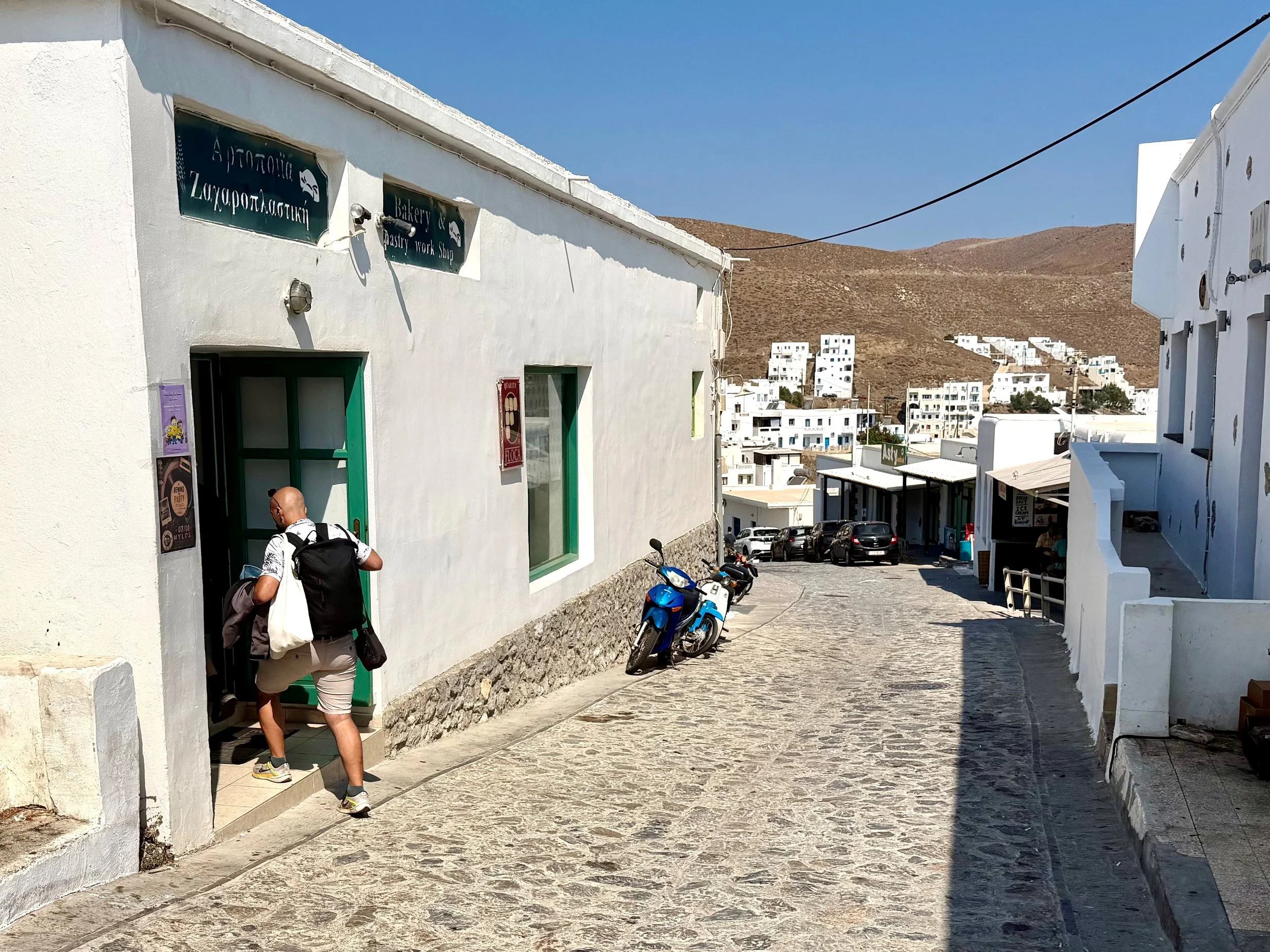
Foreign languages are not my strong suit, but I know it’s proper to learn a few key words while visiting afar. At the moment, “afar” means Greece.
And the current word I’m trying to master is “Kaliméra,” which means “Good morning.”
So I practice breaking the word down quietly to myself.
“Cali,” I whisper. Kind of like my daughter-in-law’s first name, I realize.
Then I second guess myself wondering if it’s more like “Collie” – the dog breed.
Next syllable? “Just think of a horse,” I realize. A mare. Yeah, that’s easy.
Then the ending is a simple “uhh.” But make it happy sounding.
“Cali-mare-uhh,” I try.
Take two. “Collie-mare-uhh.”
Maybe just blend those two, I think. Say it fast. Be confident and hope it works.
And so it goes on my typical morning lately as I enjoy an extended stay on a remote Greek island, Astypalea, this summer. Fortunately, the locals are very accustomed to summertime foreign tourists - and nearly all of the shop keepers speak English. Still, yours truly has a dream of mastering a few basic words.
And being out and about most mornings, my frequently used word is Kaliméra.
“Kaliméra,” I say to the lady sweeping her porch in the early morning as I stroll through the quiet streets. (I scold myself silently for mumbling. And making pitiful eye contact).
“Kaliméra!” I say (with an intentional exclamation point and a beaming smile) to the young girl working at the local bakery, my every-other-day stop for pastries. She always greets me with her big smile which convinces me that my dictation – and enthusiasm - are perfect.
Welcome to the start of my day.
But “Kaliméra” only gets you so far. Literally.
I’ve learned that sometime starting mid-afternoon you should transition from “Kaliméra” to “Kalispéra.” That technically means “Good evening,” but, apparently, you can start using Kalispéra around 3:00 pm.
I comply. And ask not why.
Then there is “Kalinýchta” which means “Good night.” But I’ve yet to be brave enough to use that one.
And when all else fails, which is often, I’ve learned to just say, “Yia sas.” I believe it’s simply a polite greeting but it’s become my go-to for:
“Hello.”
“Excuse me.”
“May I order?”
“May I pay?”
So “Yia sas” and a smile work like a charm – be I walking past someone on the street or catching the eye of a patron sitting next to me in a coffee shop.
Such a simple accomplishment – yet I’m rather proud. I’m also very comfortable here.
Astypalea has an off-season population of 1,300. I’m told the goat population is 12,000 but that remains unverified.
I think I understand small towns. I was born into one in Nebraska, North Bend, which boasted 1,174 residents the year I was born. My birth made it 1,175. And when I was nearly four we moved 15 miles away to the town of Fremont, boasting a population of 20,000-ish.
Small-town anywhere is my favorite place on Earth. Nebraska. Greece. And any spot in-between.
Why? I’m convinced in small(er) towns, there’s a common denominator everyone shares. For all the differences that may exist in professions, faith, politics – you name it – it’s that common denominator that binds the residents of these special places together.
I learned this firsthand as a kid, running Saturday morning errands with my dad.
First stop was the bank. There he’d make small talk with the teller while she exchanged all the paper bills in his wallet for “fresh, crisp” ones. (I know. Who does that? Well, my dad did. And that probably explains a lot about me.)
Then he’d sneak into the employee kitchen, help himself to a cup of Folgers coffee in a styrofoam cup, and check in on the manager-on-duty. That was my time to grab a free sucker and wait in the bank lobby.
Next was getting gas at Phillips 66. And only Phillips 66. I don’t know why but I know he enjoyed the serviceman who pumped his gas. Checked his oil. And talked to him about the horse races in neighboring Omaha.
After that we’d be off to grocery shopping at either Safeway or Hinky Dinky (yes, I kid you not). The week’s location was based on which store had the most compelling coupons in the week’s local newspaper. It didn’t matter where we went because my dad had his “favorite” check-out people at both locations. He could pick up with any of them, getting caught up on kids, grandkids, or the latest gossip.
And finally was Dave’s Drive-In Liquor. Yes, you could drive into a building for weather-proof booze. I don’t think we actually went there weekly but we certainly were regulars. I can still see “Dave” loading a case of Falstaff beer into our trunk, while talking to my dad – still in his car – about the local high school sports teams.
Errands made my dad happy.
People made my dad happy.
And I think my dad made them happy.
He treated everyone the same. Gas station attendant. Bank officer. Everyone. Because that’s what you do in small towns.
It’s the most important gift my dad gave me.
Kindness.
It counts.
And that’s a big reason I love Astypalea. Small towns have this wonderful sense of accountability folks have with each other. Sure, it’s not perfect. But it’s more perfect than not.
This morning, I was having breakfast with a local friend, Virginia. I’ve become close with Virginia and her husband over the many years I’ve been coming to Astypalea.
Virginia told me that a friend of hers, someone I don’t know, mentioned to her how much she enjoyed my friendly smile and greetings on the miscellaneous morning I’ve apparently walked past her.
When Virginia shared this with me, of course I tried to figure out who this woman was, but to no avail. I guess it doesn’t matter, does it?
Kindness should just be the norm. And I’ll never know who this woman is.
In the meantime, I’ll enjoy the remaining time I have left here.
And I’m proud to announce that I’ve learned a few additional words, as well:
“Efcharistó” means “Thank You.”
“Yamas” is used when raising your glasses in a toast to say “To our health!” or “Cheers!”
"Opa!" is one of those multi-meaning words. It can be used when someone breaks a plate or a glass, when you want to rally the group to leave or just give an energetic “Woo Hoo!”
And today I looked up a new word in the dictionary:
Kalosýni.
It means kindness.
Jim Higley is the co-founder of Puffer Hug, a company whose mission is to connect the world with kindness, one hug at a time. Learn more about Puffer Hug here.